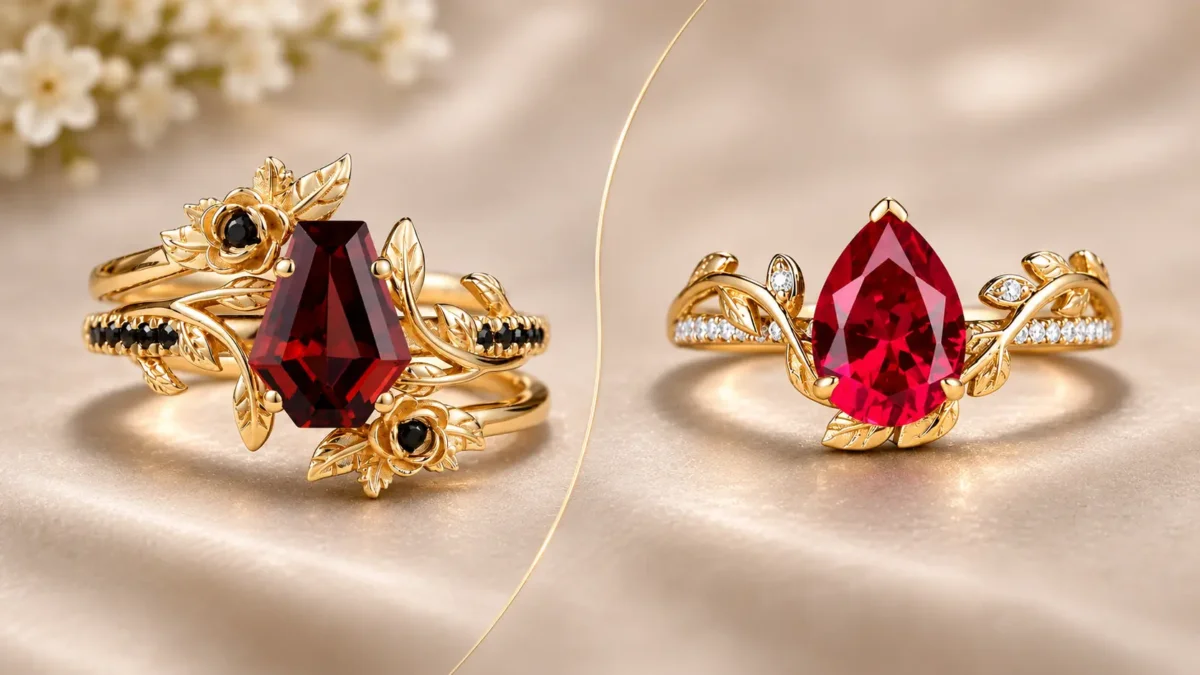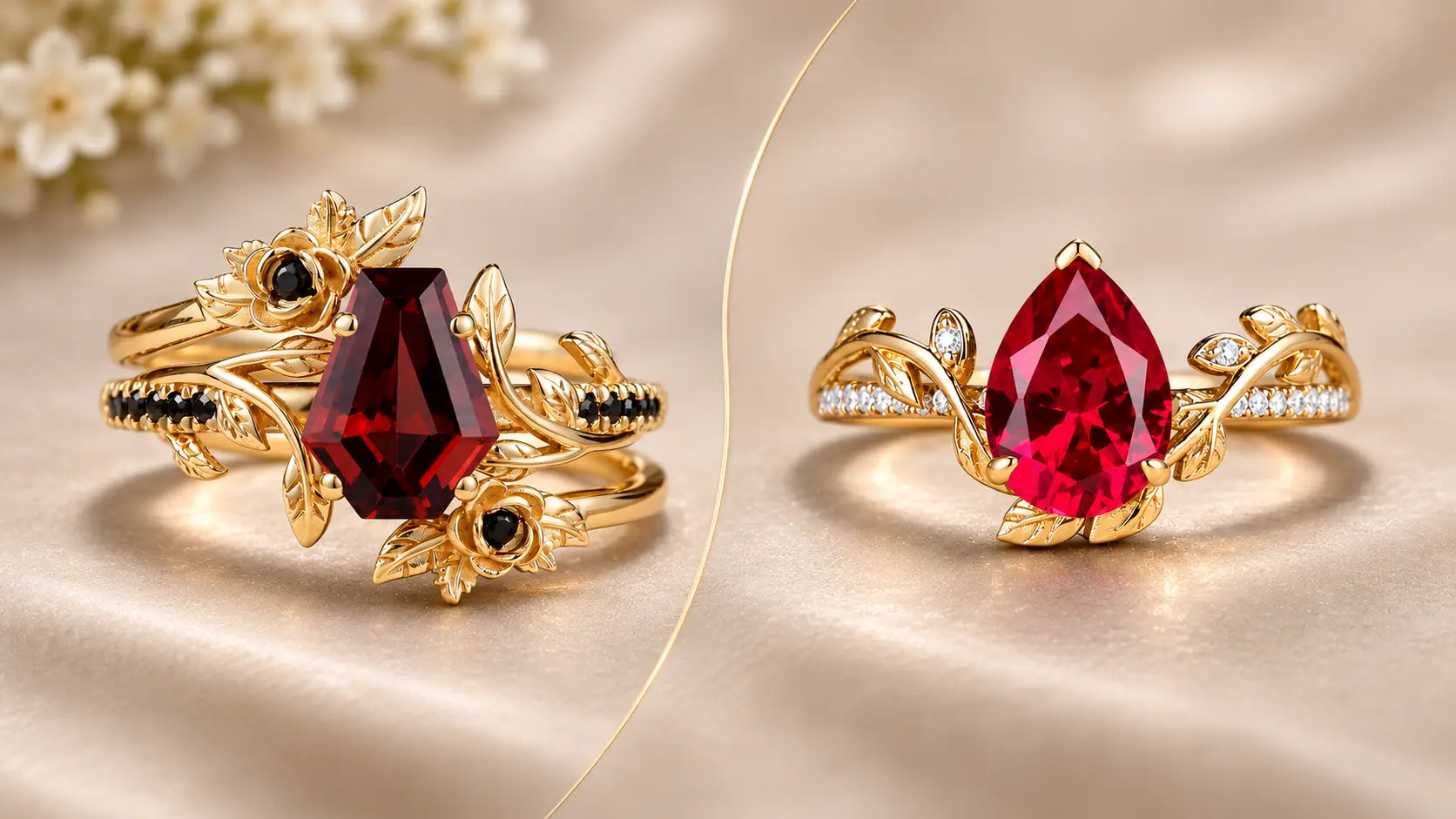
Ruby is the red variety of corundum, the mineral family it shares with sapphire. Garnet is a group of related silicate minerals, so it isn’t made of ruby or sapphire. Their reds can overlap, but ruby is generally harder, and fine natural ruby usually costs far more than common red garnet. That price comparison depends on quality, size, treatment and origin. Because the colors can look alike, a mounted red stone usually can’t be reliably identified by eye. This guide covers what separates the two, which visual clues mislead, what a gemologist can establish, and how to choose for rings, pendants and earrings.
Garnet vs Ruby: Key Differences
Garnet is a family, not a single gem. The Gemological Institute of America (GIA) lists species including almandine, pyrope and spessartine, and rhodolite is a pyrope-almandine blend. The red stones most often compared with ruby are almandine, pyrope and rhodolite, so the table focuses on those. Green garnets such as tsavorite and demantoid belong to a different conversation. Garnet’s varieties also carry different associations in jewelry traditions, but those aspects of garnet’s meaning are separate from the physical differences that matter when comparing it with ruby.
| Ruby | Red garnet (almandine, pyrope, rhodolite) | |
|---|---|---|
| Mineral | Corundum, colored red by chromium | Group of related silicates |
| Common red appearance | Finest color is a pure, vibrant red to slightly purplish red; orangy or overly purplish stones rank lower | Purple to orangy red; pure red exists but is rare above half a carat, and brownish or very dark tones are more common |
| Mohs hardness | 9 | 6.5–7.5, depending on type |
| Toughness | Excellent; no cleavage | Fair to good |
| Optical character | Doubly refractive | Singly refractive (some show anomalous double refraction, explained below) |
| Treatments | Most ruby is heated; some is diffused or glass-filled | Rarely fracture-filled |
| Typical use | Rings and everyday pieces, depending on treatment and setting | Rings, pendants, earrings |
| Price position | Fine natural ruby generally far higher | Common red garnet generally more accessible |
Mohs hardness measures scratch resistance, and the steps on the scale aren’t evenly spaced. GIA’s care guidance notes that diamond is only one number above corundum yet many times harder. Toughness is a separate property: how well a stone resists chipping or breaking when struck. A gem can be hard and still be vulnerable to a sharp knock.
The refractive-index ranges aren’t cleanly separate either. Ruby’s range is narrow, and some pyrope-almandine garnets have refractive indices that overlap it, as the International Gem Society’s species table shows.
Can You Tell Garnet From Ruby by Looking?
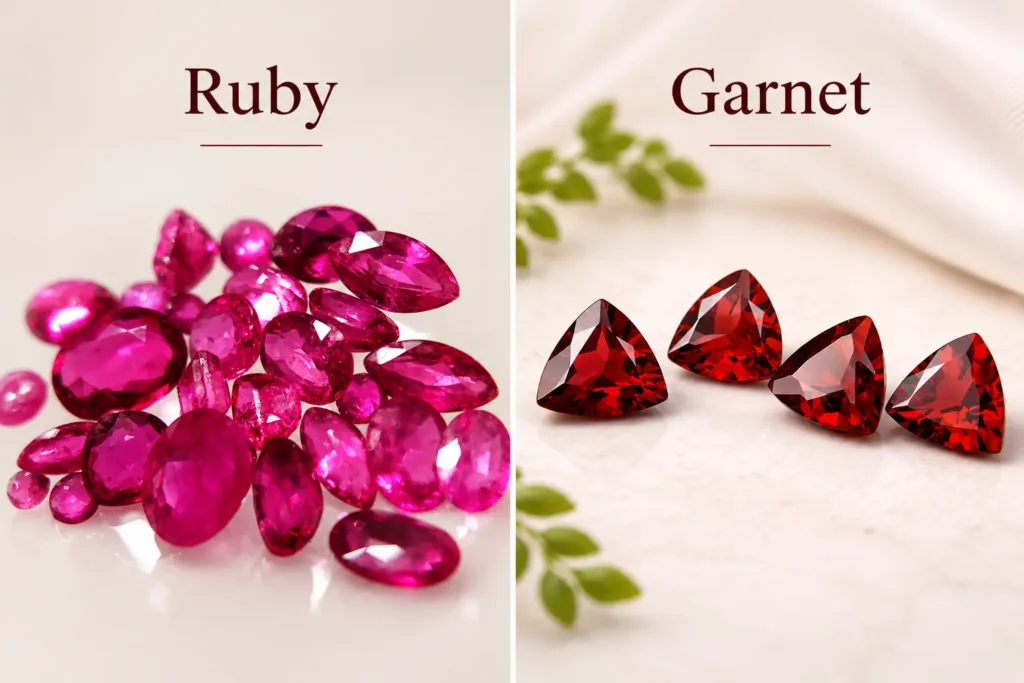
Usually not with confidence. GIA’s buyer’s guide to garnet addresses this directly: garnets do come in a pure red hue, though it’s uncommon in sizes over half a carat. Rubies, in turn, aren’t always a perfect vivid red. Some lean orangy or purplish.
A few common shortcuts don’t hold up:
- Darkness. Garnet isn’t always darker than ruby, and ruby isn’t always brighter.
- Sparkle. Brilliance depends heavily on cutting, and sparkle alone doesn’t establish identity.
- Inclusions. Rubies often contain them, and many red garnets look clean to the eye. But a visible inclusion doesn’t prove a stone is natural ruby. Treated stones can have them too, and some garnets contain them.
- Weight. Published density ranges for ruby and garnet overlap, so perceived heft isn’t a dependable test.
- Fluorescence. GIA notes that fine ruby can glow red in sunlight, but fluorescence varies and isn’t a definitive consumer test.
Don’t scratch, heat or apply chemicals to a stone to find out what it is. Those tests can damage it, and they don’t give a reliable answer anyway. A phone flashlight won’t settle the question either.
| Approach | What it can tell you | Reliability |
|---|---|---|
| Color, sparkle, heft, inclusions seen by eye | A hint at best | Weak; overlap is common |
| Gemological instruments and magnification | Optical character, refractive behavior, internal features | Strong when a trained person interprets several observations together |
| Written disclosure plus an independent report | Material identity, natural or laboratory-grown status, detectable treatments | The most authoritative route for a significant purchase |
How Do Gemologists Identify Ruby and Garnet?
Gemologists don’t rely on color. They combine observations, and the core difference is optical. Ruby is doubly refractive, meaning it splits light into two rays. Garnet is normally singly refractive, and GIA lists garnet’s birefringence as none while giving ruby’s as 0.008 to 0.010.
Real stones complicate this. Some garnets show anomalous double refraction, an apparent double-refraction effect caused by strain inside the crystal. GIA’s research has documented it in rhodolite-type pyrope-almandine garnets, and it can mislead a quick reading with a polarizing instrument. This is one reason identification relies on multiple observations interpreted together. Refractive index, optic character, dichroism, magnification and sometimes spectroscopy each contribute. No single reading settles the question on its own.
For a significant purchase, an independent lab report is the practical way to get that kind of expertise. A GIA Colored Stone Identification & Origin Report describes a ruby’s weight, measurements and color, indicates whether it is natural or laboratory-grown, names detectable treatments, and can give an opinion on geographic origin when possible and requested. It is an expert determination, not absolute proof. It also isn’t an appraisal of what the stone is worth, and GIA states that it evaluates ruby but does not grade it.
Natural, Lab-Grown, and Treated Stones: What Buyers Should Know
Four questions are easy to mix up: what the stone is, whether it formed in nature, whether it has been enhanced, and what it’s worth. They have different answers.
- Natural ruby formed in the earth. GIA advises buyers to assume a ruby has been heated, a common treatment that improves color or clarity. Rubies confirmed by an independent lab as showing no evidence of heat command a premium.
- Laboratory-grown ruby is real corundum made in a laboratory, with essentially the same chemical, physical and optical properties as natural ruby. It is not imitation. GIA notes the U.S. Federal Trade Commission’s guides permit terms like “laboratory-grown,” “laboratory-created” or “[manufacturer name]-created.”
- Diffusion-treated ruby has been treated to introduce color-producing elements into the stone. GIA notes that color penetration varies: in some stones it extends throughout the material, while in others it remains shallow enough that surface damage or re-cutting can remove the treated color.
- Glass-filled ruby has surface-reaching fractures filled mainly with high-lead-content glass. GIA says there are large numbers of these in the market. They’re worth less than heated ruby, and they need more careful handling.
- Natural red garnet is typically untreated. GIA says garnets might rarely be fracture-filled.
- Imitations are different materials made to resemble a gem, and any gem can be imitated. A glass imitation of ruby is a different thing from a laboratory-grown ruby.
For a significant purchase, a few questions are worth asking the seller:
- Is the stone natural or laboratory-grown?
- Has it been treated or filled, and in what way?
- Is that information in writing?
- Is an independent identification report available?
A modest, inexpensive piece doesn’t need expensive laboratory testing. The questions matter more as the price rises.
Is Ruby More Expensive Than Garnet?
Fine natural ruby generally commands much higher prices than common red garnets such as almandine and pyrope. GIA says ruby can command the highest prices of any colored gemstone. But “ruby costs more” isn’t a rule for every pair of stones.
Several things drive the difference:
- Color and quality. Color is the most important factor for ruby, and inclusions that reduce transparency or brightness lower its value significantly. Garnet is largely valued by color too, and GIA describes it as ranging from affordable dark reds to rare, valuable greens.
- Size. Fine ruby over one carat is very rare, and price per carat rises significantly as size increases. Garnet varies: GIA says almandine is far more common in larger sizes, so its price doesn’t climb dramatically with size.
- Natural or laboratory-grown. These are priced differently, so compare them separately.
- Treatment. Diffused and glass-filled ruby are worth less than heated ruby, and unheated ruby with a lab report can carry a premium.
- Which garnet. Rare varieties like tsavorite and demantoid occupy a very different market from common red garnet. GIA says garnet has no standard quality-grading scale, and ruby and garnet aren’t priced by one shared system.
So a treated or lower-quality ruby and a fine rare garnet may not compare the way the headline suggests. This article doesn’t give per-carat figures because published numbers vary widely and depend on exactly these factors.
Which Is Better for Everyday Jewelry: Garnet or Ruby?
For a ring worn daily, ruby generally has the advantage. GIA calls corundum “relatively hard and tough”, with excellent toughness and no cleavage, which makes it a great choice for rings subject to daily wear. That comes with a condition: GIA describes ruby as very durable when no treatment-related durability concerns apply. Setting design matters too. A protective setting helps any stone.
Garnet isn’t unsuitable for rings. GIA says garnets have fair to good toughness and are durable enough for all jewelry styles with proper care, though they shouldn’t take hard blows or rough wear. In practice that makes pendants and earrings, which take fewer knocks, an easy fit.
| Piece | Reasonable fit |
|---|---|
| Everyday ring | Untreated or heat-treated ruby without durability-sensitive filling, preferably in a protective setting |
| Occasional ring | Either |
| Pendant or earrings | Either |
| Budget-conscious red stone | Common red garnet |
This table reflects editorial judgment built on GIA’s property data, not a fixed rule.
Care depends on treatment. GIA recommends warm, soapy water for ordinary ruby and garnet jewelry, but fracture-filled, cavity-filled, or dyed rubies should be cleaned only with a damp cloth. Ultrasonic and steam cleaning are usually safe for untreated, heat-treated, and lattice-diffused ruby, but not for those more vulnerable treatments. Even lemon juice can damage high-lead glass fillings. For garnet, ultrasonic cleaning is usually safe unless the stone has fractures; steam cleaning isn’t recommended.
Which Should You Choose?
Choose ruby when higher scratch resistance matters, such as for a ring worn every day, and you understand the stone’s treatment and price. Consider a common red garnet when you want an attractive red stone at a more accessible price. Either can suit pendants and earrings. Whichever you pick, confirm identity and treatment before a significant purchase.
Neither stone is better across the board. They suit different budgets and different uses.
The Bottom Line
Ruby and garnet are different minerals whose reds can overlap. Appearance alone isn’t a dependable way to tell them apart, and price and suitability depend on more than the name. For a significant purchase, written disclosure of whether the stone is natural or laboratory-grown, details of any treatments, and an independent gemological report can provide much stronger evidence than appearance alone.