Lapis lazuli is most often associated with wisdom, truth, communication, and intuition in modern crystal practice. Its historical value is better documented: museum records show it in royal and elite objects from ancient Mesopotamia and Egypt. It is also a blue rock, not a single mineral, and today’s symbolic meanings are interpretations, not demonstrated effects. This guide keeps those layers apart: what people mean by lapis lazuli today, what artifacts and texts actually establish, what the stone is made of, and how to wear it without damaging it.
What Does Lapis Lazuli Mean?
In modern crystal practice, lapis lazuli stands for wisdom and truth. It is also linked to communication and self-expression, usually through the throat chakra, and to intuition, usually through the “third eye.” The stone’s deep blue suggests depth and calm, which may be why those associations stick, though that is an interpretation, not a documented origin. Chakra concepts have older roots in Indian spiritual traditions, but the specific pairing of lapis lazuli with the throat and third-eye chakras belongs to contemporary crystal practice. The historical sources discussed below do not establish those pairings.
Royalty and status rest on firmer ground, because lapis objects survive from elite settings. But an artifact shows that people used a material, not what it meant to them. A bead in a queen’s headdress tells us lapis was valued; it doesn’t tell us the wearer thought of it as wisdom or truth. And no stone can make anyone wiser, more honest, or more intuitive. These meanings are best read as symbols people choose to carry.
What Is Lapis Lazuli?
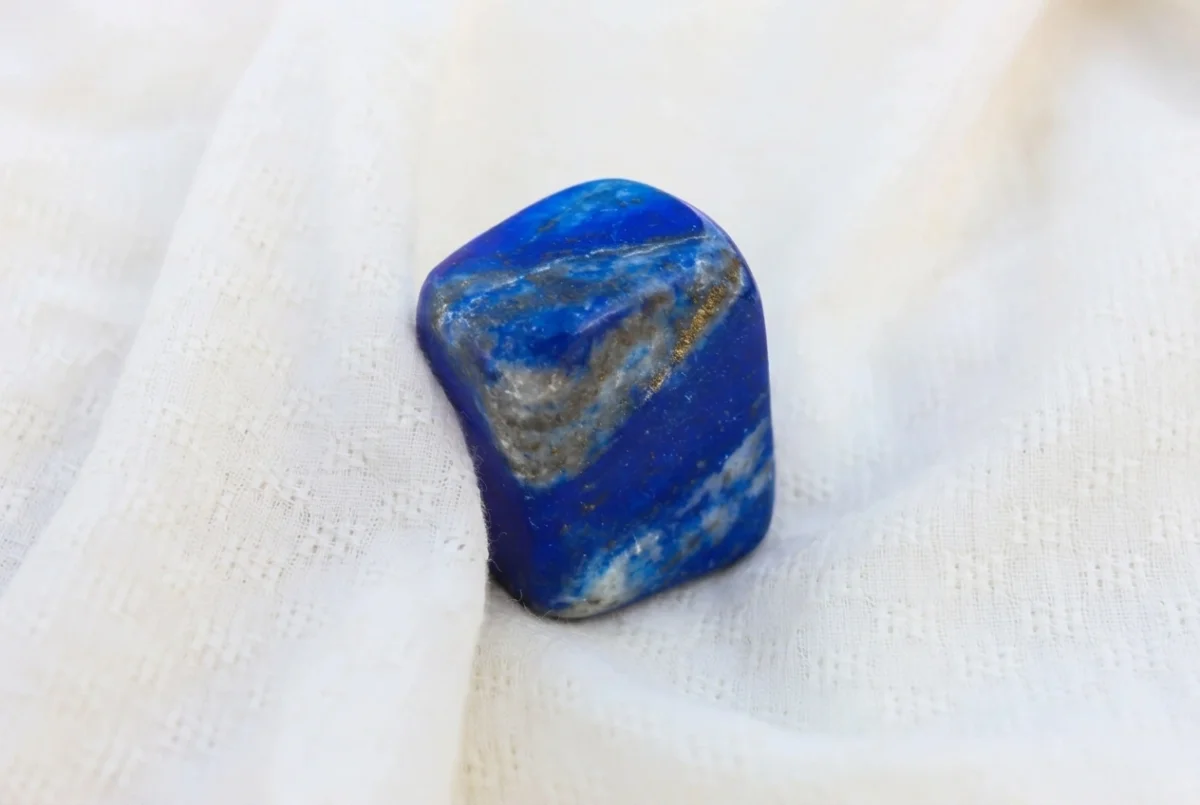
Lapis lazuli is a rock, an aggregate of several minerals, mainly lazurite, calcite, and pyrite, according to the Gemological Institute of America (GIA). The blue comes from minerals of the sodalite group, with sulfur-based color centers behind the color. Lazurite is often named as the blue ingredient, but GIA’s technical review of historical pigments says the source of the blue is still an open question. Several publications credit haüyne, a related mineral. Studies it cites find haüyne dominant in lapis from Afghanistan’s Sar-e-Sang mines and Canada’s Baffin Island, while material from Chile has been described as lazurite-dominant. In plain terms, the blue-bearing mineral varies from stone to stone, so two pieces of lapis can differ in composition.
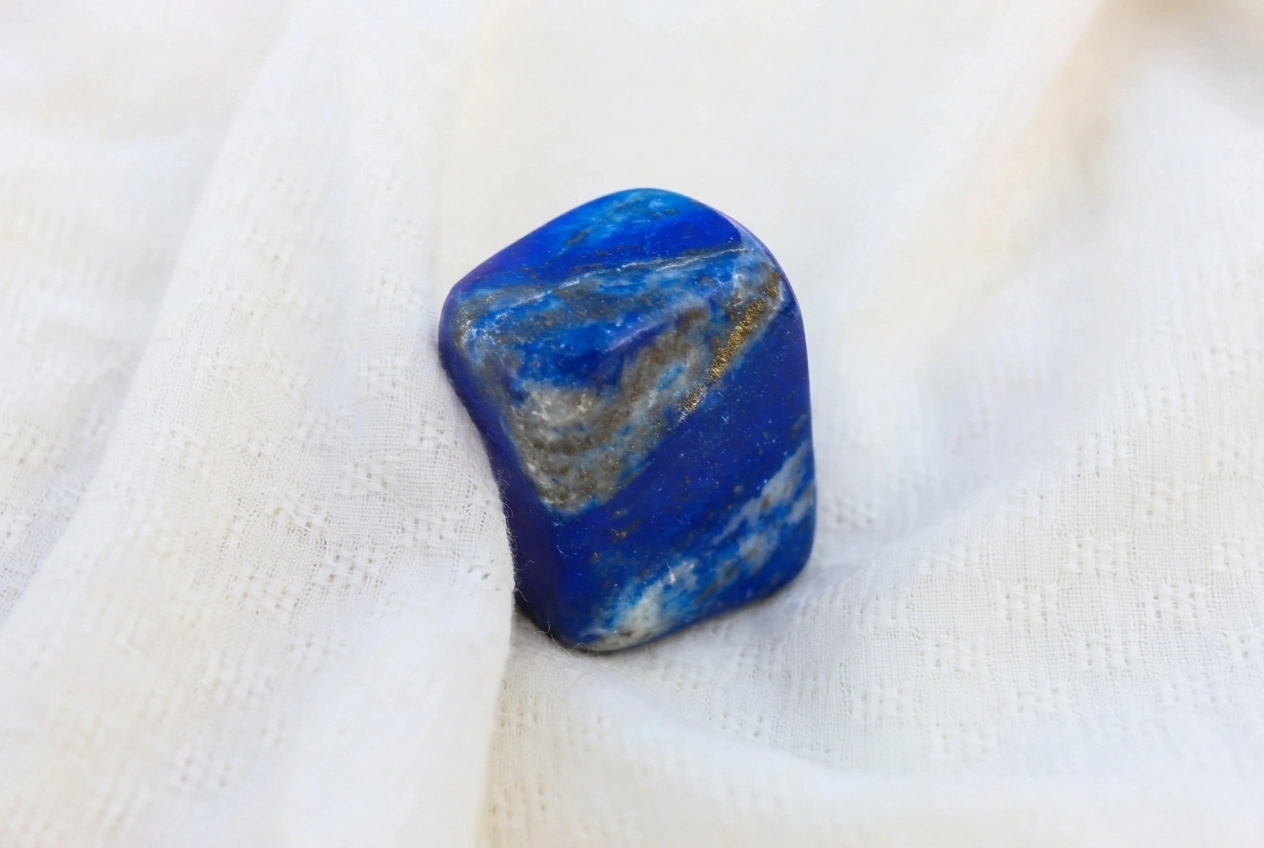
The gold flecks are pyrite, and white patches are usually calcite. Neither is required. GIA’s buyer’s guide describes the most prized lapis as having no visible calcite, though it might have gold-colored pyrite flecks. Too much pyrite gives a dull, greenish look, and white calcite streaks lower value. Genuine lapis therefore doesn’t need visible pyrite, and its color can range from greenish blue to violetish blue.
What History Actually Shows About Lapis Lazuli
Surviving objects and texts show that lapis lazuli was prized for thousands of years. They don’t show a single shared meaning, so each example below is described for what it can and can’t establish.
Queen Puabi and the Royal Cemetery of Ur
The Penn Museum’s frontlet B17708 comes from grave PG 800 in the Royal Cemetery at Ur, in present-day Iraq, and dates to about 2600–2450 BCE. It is made of gold, lapis lazuli, and carnelian: twenty gold rings strung with carnelian and lapis barrel beads. It was found on the skull of Queen Puabi and was apparently worn at the forehead, beneath other gold wreaths.
The object shows lapis in elite adornment in a royal burial. The museum record doesn’t say what the stone meant to Puabi or where it was mined.
Lapis Lazuli in Ancient Egypt
The Metropolitan Museum of Art holds a lapis lazuli amulet of Maat from Egypt’s Late Period, about 664–332 BCE. The Met describes Maat as the embodiment of truth in Egyptian thought, and she appears in its collection as a goddess whose figure could be offered to the gods or weighed against the heart of the deceased. The amulet shows that Egyptians made lapis amulets of her. It doesn’t show that lapis meant truth to Egyptians in general.
Tutankhamun’s gold mask is another famous example, but its details need care. Excavation cards by Alfred Lucas in the Griffith Institute’s Tutankhamun archive describe lapis lazuli among the inlays of the eyes and eyebrows, alongside calcite and obsidian, and identify the headdress stripes as lapis lazuli-colored glass. These are descriptions from the 1920s excavation records, not modern laboratory analysis, and the blue stripes are glass, not stone.
Lapis Lazuli in Sumerian Literature
In the Sumerian poem Inanna’s Descent, the goddess hangs small lapis beads around her neck and carries a lapis measuring rod and line. Both are removed from her at the gates of the underworld, according to the Oxford translation. This is literary evidence, not an excavated object, and the poem doesn’t explain what the lapis signifies.
From Stone to Ultramarine
Lapis was also ground into a pigment. The Fitzwilliam Museum’s Illuminated project describes ultramarine as a pigment purified from lapis lazuli mined in Afghanistan, named for coming “beyond the sea,” and used lavishly by medieval and Renaissance illuminators. GIA notes that it was so costly that only wealthy patrons could afford it, and that azurite, not lapis, was the backbone of European blues. Not every blue in an old painting is ultramarine.
Synthetic ultramarine later made the color affordable, and the Fitzwilliam notes that natural and synthetic versions can be hard to tell apart.
Which Lapis Lazuli Meanings Are Historical and Which Are Modern?
Sorting the common meanings by what supports them makes the pattern clear.
| Association | What the evidence supports |
|---|---|
| Royalty and status | Supported by lapis in surviving elite objects, such as the Ur frontlet |
| Divine associations | Sumerian poetry gives lapis to a goddess’s regalia, and an Egyptologist points to Egyptian texts describing a god’s hair as lapis |
| Truth | A lapis Maat amulet exists, but a general link between lapis and truth isn’t established |
| Protection | Amulet use is documented; a protective effect is not scientifically demonstrated |
| Wisdom and intellect | A common modern crystal interpretation; no ancient origin established |
| Communication and intuition | Contemporary spiritual interpretations, tied to the throat chakra and third eye |
Lapis lazuli’s historical value and use in elite objects are documented. Wisdom, communication, and intuition are prominent in modern crystal writing, but the sources reviewed don’t establish when those particular associations began.
How to Wear and Care for Lapis Lazuli
GIA lists lapis at 5 to 6 on the Mohs scale, depending on composition, with fair toughness (GIA care guide), and its buyer’s guide calls it durable enough for daily wear. That isn’t the same as scratch-proof: lapis is softer than quartz, a common ingredient in everyday grit, so scratches and dull spots are a real risk. In practice, pendants and earrings take fewer knocks than a ring on a working hand. Store lapis apart from harder gemstones so they can’t scratch it.
Clean lapis with warm, soapy water, and never with steam or ultrasonic cleaners. Treatments make that more important. Lapis may be dyed to improve its color or conceal calcite, and undyed stones may be impregnated with wax or oil; GIA says these treatments have only fair stability and that a gemologist can detect them. Dye can come off with acetone or denatured alcohol, and wax sealers can break down with heat or solvents. Avoid those chemicals. Before cleaning with warm, soapy water, test a small, inconspicuous area because some dye treatments are unstable.
Not all lapis is treated, and treatment isn’t a flaw. The issue is disclosure, a principle that applies to other gems too, such as heat-treated citrine. Pyrite flecks settle nothing, because dyed lapis has them too, and GIA notes that glass, plastic, and ceramic imitations exist. For ordinary jewelry, ask the seller whether the stone is dyed or treated and keep the answer in writing. A laboratory report mainly makes sense for an expensive stone.
What Lapis Lazuli Symbolism Doesn’t Prove
Personal meaning is real to the people who hold it. A piece chosen as a reminder to speak honestly or trust your instincts can do that job for its owner. But that is symbolism, not a measured property of the stone. Chakra links are contemporary spiritual interpretations, and claims that lapis eases anxiety, lowers blood pressure, improves sleep, or treats illness aren’t established medical effects. A stone shouldn’t replace professional healthcare.
The Bottom Line
Lapis lazuli’s leading modern meanings are wisdom, truth, communication, and intuition. What history documents is different: a blue rock prized as a luxury material in royal and elite settings, from the Ur frontlet to Egyptian amulets and Sumerian poetry. The historical evidence and modern symbolic interpretations tell different parts of the stone’s story, and understanding that distinction gives its meaning useful context. If you wear it, treat it as a softer, treatable stone, and ask whether it has been dyed.