Act quickly. Blot the oil, pretreat the spot with liquid laundry detergent or a stain remover made for oily stains, wash in the warmest water the care label allows, and keep the garment out of the dryer until the stain is gone. That is the core of guidance from the American Cleaning Institute (ACI) and university extension services. It works best on fresh stains. Old or heat-set stains can often still be treated, but no source promises that every one will come out.
This guide is built from published cleaning guidance, not from product testing by HerStyleReport.
How to Remove a Fresh Oil Stain
These steps are for washable garments.
- Check the care label. If it says dry-clean only, skip to the professional cleaning section. An earlier Iowa State University Extension guide notes that stains on most dry-clean-only items can’t be removed successfully at home.
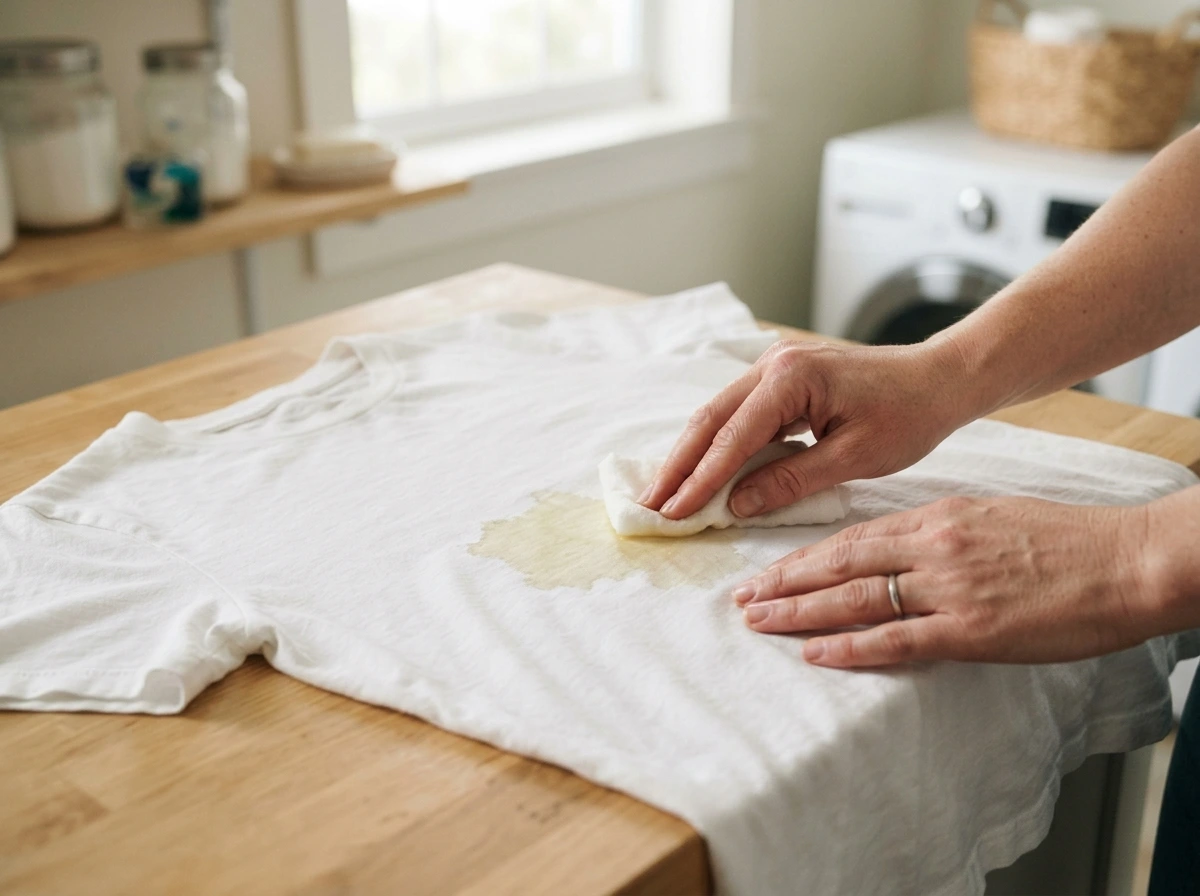
- Blot, don’t rub. Lift excess oil with a clean white cloth or paper towel. Iowa State advises against rubbing the area, because rubbing can spread the stain. Whirlpool suggests gently scraping thick grease with a dull butter knife and placing cardboard behind the stain so it doesn’t soak through. Maytag warns that printed paper towels can transfer color.
- Test your pretreatment. Both Iowa State and New Mexico State University (NMSU) Extension recommend trying any stain remover on a hidden seam or hem first.
- Pretreat. For grease and oil, ACI recommends a prewash stain remover, liquid laundry detergent, or a liquid detergent booster. Iowa State describes heavy-duty liquid detergent as convenient for oil stains. Follow the product’s directions. Whirlpool and Maytag each describe letting the pretreatment sit for about 10 minutes.
- Wash in the warmest water the label allows. Whirlpool recommends using the warmest water permitted by the care label to help loosen grease and oil. ACI gives the same washing-temperature guidance.
- Check before drying. Iowa State advises inspecting laundry before it goes in the dryer, and ACI says not to dry it until the stain is gone. Air-drying is the usual advice (Whirlpool, Maytag). As an editorial tip, check the dry garment in good light, since a wet spot can hide a leftover mark.
- Repeat if needed. If a mark remains, ACI says to repeat the steps. Don’t dry the garment in between.
Iowa State groups cooking oils, butter, salad dressing, mayonnaise, and hand lotion in the same oil-based stain family, so this method applies to all of them.
What to Do With Old or Set-In Stains
Fresh stains are much easier to remove than those more than 24 hours old, according to Iowa State’s earlier guide. Time isn’t the only factor. Oil bonds more firmly to durable-press fabrics, and Iowa State says that oil on acrylic, nylon, olefin, and polyester that dries in the dryer or is ironed in is “extremely difficult” to remove.
The manufacturer guidance for a stain that has dried goes like this:
- Pretreat with dish soap, a stain remover, or a liquid enzyme detergent and let it sit about 10 minutes (Maytag, Whirlpool).
- Soak in warm water. Both appliance makers describe soaking for at least 30 minutes.
- Wash in the warmest water the care label allows, then air-dry.
Iowa State’s earlier publication also describes solvent-based pretreatment products as particularly useful for stains more than two days old or set by dryer heat. Some solvent-based pretreatments are flammable and require good ventilation. Follow the product label, keep them away from ignition sources, and complete any required rinsing or drying before laundering. Don’t use a home treatment on garments labeled dry-clean only.
Repeating the treatment is standard advice (ACI, Iowa State), but none of these sources gives a success rate or a limit on how old a stain can be. A dried or aged oil stain may lighten without disappearing completely.
What if the Clothes Have Already Been Washed or Dried?
Washed but not dried. Treat it again using the steps above. ACI’s guidance is to repeat the treatment and keep the garment out of the dryer. Whirlpool suggests an enzyme-based cleaner rather than dish soap for a stain that survived washing and drying. Iowa State notes that most detergents contain lipase, an enzyme aimed at fats.
Already tumble-dried. Heat makes a stain more permanent, according to Iowa State, but it doesn’t make treatment pointless. Whirlpool, Maytag, and Iowa State all describe re-treating, with solvent-based pretreatments especially suited to dryer-set oil. Expect a harder job, especially on polyester and other synthetics, and stop if the fabric starts to show wear.
Fabric-Specific Precautions
Fiber content changes what is safe, and the hang tag or care label is the first place to look.
- Cotton. Iowa State says gentle to vigorous rubbing and agitation under running water helps remove oil from shirt-weight cotton and cotton-polyester blends. Chlorine bleach isn’t needed for oil and can weaken cotton with repeated use.
- Denim. Whirlpool says sturdy fabrics like denim can be gently scrubbed after dish soap is applied. Iowa State points out that indigo dye bleeds, so test first.
- Polyester and durable-press fabrics. Treat these quickly. Synthetic fibers attract oil and are heat-sensitive, so keep drying and ironing off the table until the stain is gone (Iowa State).
- Wool. Iowa State says wool is damaged by chlorine bleach, and many wool garments are dry-clean only. If the label allows washing, Maytag suggests pretreating with mild detergent and washing at the warmest temperature the tag permits. NMSU’s general guidance is “just warm” for woolens, not hot.
- Silk. Silk is also damaged by chlorine bleach (Iowa State), and the guidance reviewed here doesn’t offer a dependable home method for oil on silk. Blot gently and consult the label. A professional cleaner is the safer route.
- Dry-clean-only, embellished, or specially finished clothing. Iowa State warns that flocking and sequin adhesives can dissolve in dry-cleaning fluid, and that finishes can affect stain removal. Don’t experiment on these.
Which Cleaning Products Help—and Which to Avoid
Supported by the sources:
- Liquid laundry detergent or a prewash stain remover. ACI’s first-line recommendation for grease and oil.
- A small amount of hand dishwashing liquid. Whirlpool and Maytag both describe it, and NMSU lists it among solvents for oily stains. Rinse it out thoroughly before the garment goes in the washer.
- Enzyme detergents for stains that survived a wash (Whirlpool, Maytag).
Use with qualifications:
- Cornstarch or cornmeal. NMSU lists both as absorbents for a stain-removal kit but doesn’t give a step-by-step method, and the sources reviewed here don’t compare how well they work. If you use one, treat it as an optional first step on a fresh stain, brush it off, and still launder.
- Baking soda. Whirlpool and Maytag describe sprinkling it on blotted oil and leaving it for 24 hours before treating with dish soap. The sources reviewed here that came from textile and cleaning authorities (ACI, Iowa State, NMSU) don’t list this method, so treat it as manufacturer-supported but optional.
- Commercial stain removers. Iowa State says pretreatment products are generally effective as advertised, though it notes that “limited testing” found some commercial removers less effective than advertised. Follow the label.
Best skipped:
- Dishwasher detergent. Iowa State says it is highly alkaline, can irritate skin, and may fade colors or damage wool, silk, or nylon. It is not the same as hand dishwashing liquid.
- White vinegar as a routine treatment. Iowa State says vinegar may weaken cotton, rayon, acetate, triacetate, and silk fibers. Whirlpool and Maytag mention it only with testing and a thorough rinse, and Maytag advises against regular use on clothing.
- Hairspray. Whirlpool says there is little credible research behind it.
- Acetone and other strong solvents. Iowa State says acetone dissolves acetate fabrics and can damage triacetate and modacrylic.
- WD-40 and similar petroleum products. At least one manufacturer page suggests them for stubborn stains, but they’re flammable and independent support is thin, so this guide doesn’t recommend them.
- Mixing products. NMSU and Iowa State both warn against combining stain removers, noting that bleach and ammonia together produce toxic fumes. If you need a second product, rinse thoroughly between them.
Why Drying Before Removing the Stain Matters
Two separate concerns apply here.
Heat sets stains. ACI, Iowa State, and NMSU all advise keeping a stained garment out of the dryer until the stain is gone, and not ironing or pressing it either.
Heavily oil-soaked cloth can be a fire hazard. In a 1992 notice, the U.S. Consumer Product Safety Commission, the U.S. Fire Administration, and the International Association of Fire Chiefs warned that kitchen towels used to wipe or drain large quantities of vegetable cooking oil can catch fire if heated. Normal laundering may not remove all the oil, and towels dried in a dryer or left in a warm pile may begin to smoke. The notice was based on preliminary lab tests.
A small oil spot on a shirt is different from a towel used to absorb a large quantity of cooking oil. For an ordinary stain, keep the garment out of the dryer while treating it so heat doesn’t set the mark. For heavily oil-soaked wiping cloths, the CPSC recommends disposal rather than relying on ordinary laundering or air-drying. Its guidance also warns against tightly packing discarded oily cloths or exposing them to heat.
A Quick Decision Table
| Situation | Best first move | What to avoid |
|---|---|---|
| Fresh spill, washable garment | Blot, pretreat with detergent or stain remover, wash warm per the label | Rubbing; the dryer |
| Dried stain, not yet washed | Pretreat, allow time according to product instructions, wash per the label; soaking is an option | Drying with the stain still visible; ignoring product instructions |
| Stain remains after washing | Re-treat (enzyme detergent is an option), wash again, air-dry | Drying “just to see” |
| Already tumble-dried | Re-treat and repeat as needed; consider a label-approved solvent-based pretreatment spray | Ironing; expecting a guaranteed result |
| Polyester or durable-press | Treat as soon as possible | Letting it dry or ironing it in |
| Wool or silk | Follow the label; consult a cleaner if unsure | Chlorine bleach; dishwasher detergent |
| Dry-clean-only, sequined, flocked | Blot and go to a cleaner | Home solvents and soaking |
When Professional Cleaning Is Better
Iowa State’s earlier guidance is to blot excess stain from a dry-clean-only garment and get it to the cleaner promptly, within 24 to 48 hours, telling them the fiber content and what caused the stain if you know. The same goes for silk and wool items you aren’t confident about, garments with embellishments or special finishes, and stains that survive repeated careful treatment on a garment you care about. Suede, leather, and fur need specialist cleaning that not every dry cleaner offers.
The Bottom Line
Most oil stains on washable clothes respond to the same sequence: blot, pretreat, wash warm per the label, check, and air-dry while the stain remains. Old and dryer-set stains take more effort, with no guaranteed result.
For delicate or dry-clean-only garments, professional cleaning may be safer than repeated home treatment. Heavily oil-soaked wiping cloths require separate fire-safety precautions and should not be treated like ordinary stained clothing.