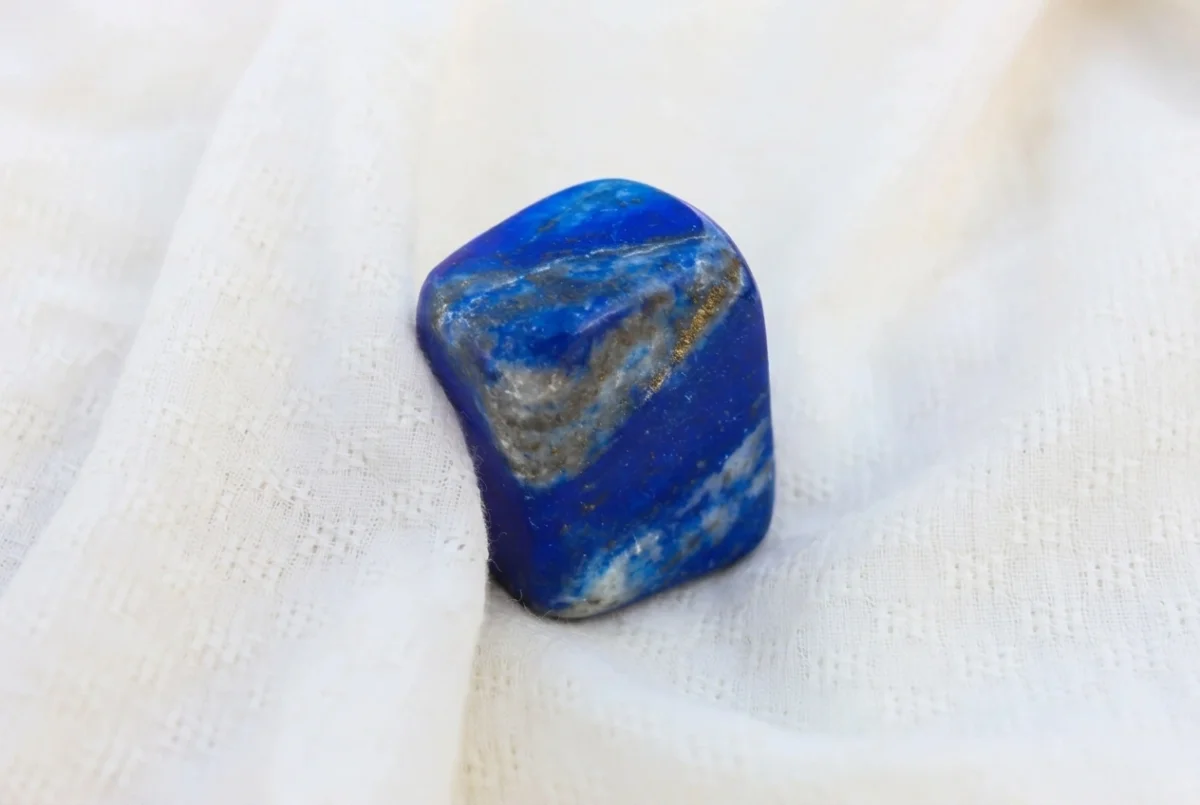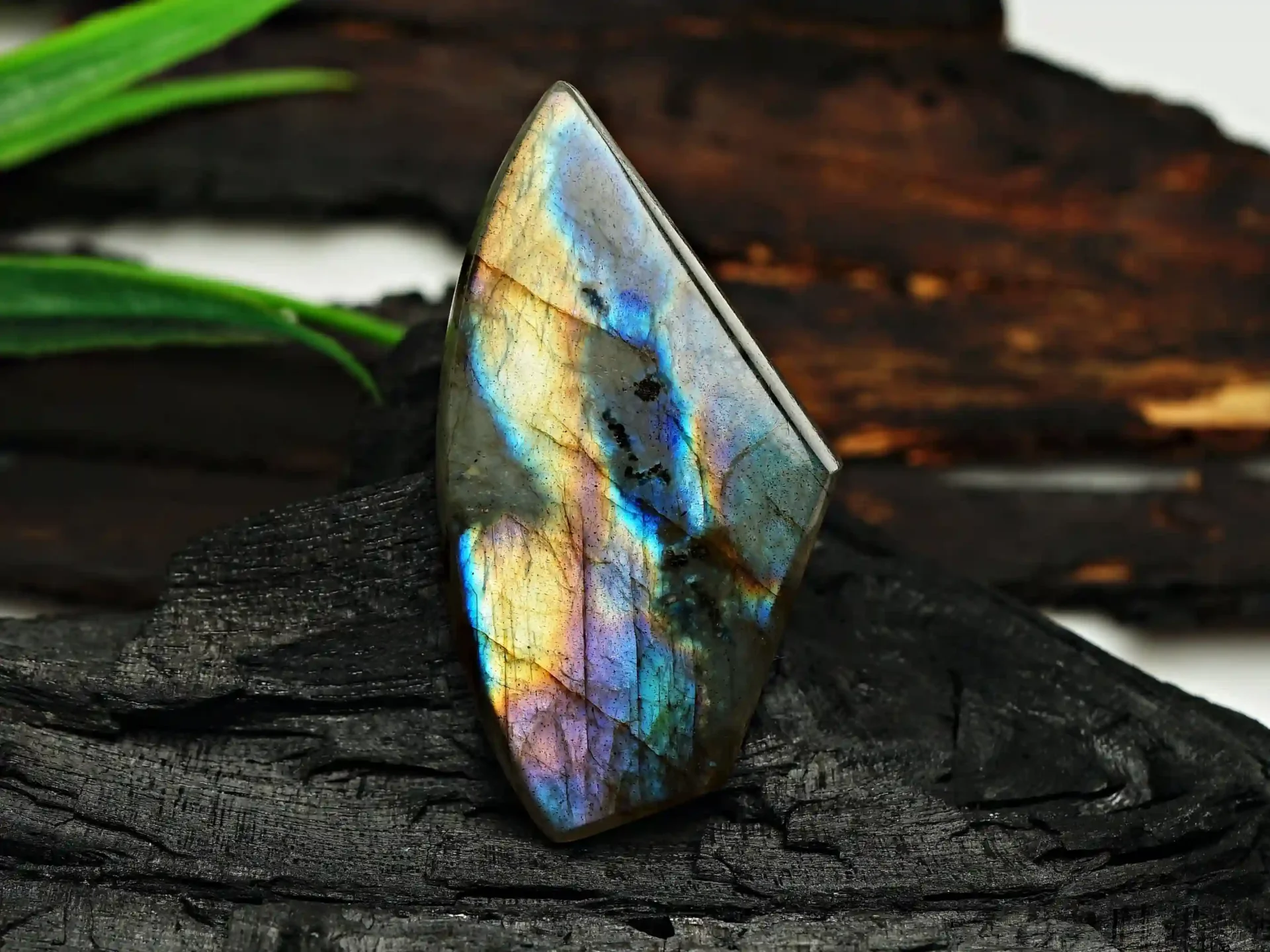
Labradorite is most often associated with transformation, intuition, protection and inner strength. These are contemporary symbolic meanings, not demonstrated effects, and much of their appeal comes from the stone’s behavior. It looks like dark gray rock until you turn it in the light, and then it flashes blue, green or gold. Below is what people mean when they call labradorite a stone of change, what actually causes the flash, how to read the popular Northern Lights story, and what to know before wearing it.
What Does Labradorite Symbolize?
Transformation is the meaning most closely tied to labradorite. The stone seems to change as you move it, and the connection to personal change is easy to see: the color is hidden until the light and angle are right, so the stone becomes a symbol of something emerging after a shift. That is an interpretation people bring to the stone, not a documented origin of the idea.
Intuition is the second common association. Labradorite is usually described as a stone for paying attention to your inner sense of things, in part because its best colors reveal themselves only when you look closely.
Protection and inner strength round out the list. In crystal practice, protection usually means a feeling of being shielded or steady, and inner strength means resilience during a transition. People often choose labradorite as a reminder of those intentions during a move, a career change or a difficult year.
These meanings come from modern crystal practice and personal use, and they vary by source. Chakra and zodiac pairings, for example, differ from one guide to the next, so there is no standard assignment to report.
Why Does Labradorite Flash?
The flash is called labradorescence, and it is an optical effect, not a surface coating or a pigment. Labradorite is a plagioclase feldspar, and as it cooled slowly deep in the earth, very thin, regular layers formed inside the crystal. According to the Gemological Institute of America, light reflecting off these layers interferes with itself, so some colors reinforce each other and others cancel. A Memorial University geologist describes the same mechanism, optical interference from microscopic exsolution lamellae of consistent thickness. That explains why the effect changes with the viewing angle. The colors appear when the layers face you at the right direction and fade when you turn the stone away. GIA compares iridescence, the broader family of optical effects that includes labradorescence, to the shifting colors of a soap bubble.
The flash is most commonly blue, then green, gold, orange and violet, against a body that is typically dark gray to black. Opal’s play-of-color has a different cause; pink opal, for example, is a common opal that doesn’t show it at all. Labradorescence is the effect named for labradorite and most associated with it.
Two names cause confusion. Spectrolite is a rare variety from Finland known for fuller-spectrum color, per GIA. “Rainbow moonstone” is a trade name for a pale, transparent labradorite with colorful flashes. It isn’t true moonstone, which is a different feldspar, as Gem-A explains.
The Northern Lights Story: What Is Documented
Many pages repeat a story about a hunter freeing the Northern Lights from stone, usually with no source. One telling can be traced to a named author: Jason Sikoak, a Nunatsiavut Inuit artist originally from Rigolet, whose account was published in Inuktitut magazine (Inuit Tapiriit Kanatami) in the Summer 2019 issue. He introduces it as a story told to him.
In his telling, a powerful angakok wanted the northern lights for himself and trapped them in the rocks at his home on the northern Labrador coast. The nearby community suffered in the dark. A great hunter, whom the people relied on to lead, couldn’t persuade the angakok to give the lights back and killed him, but the spell outlived him. The hunter then found the brightest spot in the rock and drove his harpoon into it. Some of the lights returned to the sky. Others stayed in the stone, and that is what we call labradorite today.
A few cautions keep this accurate:
- Sikoak’s account is a telling he shares, not proof of when the story began. Publication in 2019 doesn’t date the story, and we haven’t found documentation that settles how old it is or how widely it’s told.
- Versions differ. Artist Glenn Gear’s 2021 installation at the Winnipeg Art Gallery, for instance, presents an Inuit origin story from Nunatsiavut in which an elder or shaman, not a hunter, strikes the labradorite.
- The story is folklore. It doesn’t explain the stone’s optics, which come from the layered crystal structure described above. The story does show why people connect the stone with the aurora: the blues and greens resemble auroral displays, as the Memorial University geologist notes.
Is Labradorite Durable Enough to Wear?
It depends on the piece. Labradorite measures 6 to 6.5 on the Mohs scale and has two directions of perfect cleavage, meaning it can split along flat planes. The International Gem Society lists its wearability as poor and advises avoiding rough handling. In practice:
- Pendants and earrings are the safer choices, since they take fewer knocks.
- Rings and bracelets are riskier, especially in exposed settings. A protective setting helps.
- Cleaning: Retailers such as Fire Mountain Gems recommend mild soap, lukewarm water and a soft cloth, and advise against ultrasonic and steam cleaners. Store it away from harder stones that could scratch it.
- Buying: For an expensive piece, ask the seller about gemstone identification, treatments and return policies. Independent laboratory identification may be worth considering for higher-value purchases.
What Gemstone Symbolism Does and Doesn’t Establish
The symbolic meanings above describe what people associate with labradorite and why the stone invites those associations. They don’t show that the stone changes a person’s circumstances, intuition or protection. Claims that labradorite relieves anxiety, balances hormones or treats illness aren’t established by gemstone science, and a stone isn’t a substitute for professional care.
That doesn’t make a keepsake meaningless. A piece worn as a reminder of a personal change can matter to its owner. Labradorite’s symbolism can be appreciated alongside its unusual optical properties without treating traditional stories or personal beliefs as scientific evidence.
The Short Version
Labradorite symbolizes transformation, intuition, protection and inner strength in contemporary crystal practice, and its flash is a layered-crystal optical effect, not a coating. The Northern Lights story has a named, attributable telling in Jason Sikoak’s account, but one telling can’t prove how old the story is. For jewelry, favor pendants and earrings, handle the stone gently, and treat the symbolism as meaning you choose, not a measured effect.